
AI for building code compliance
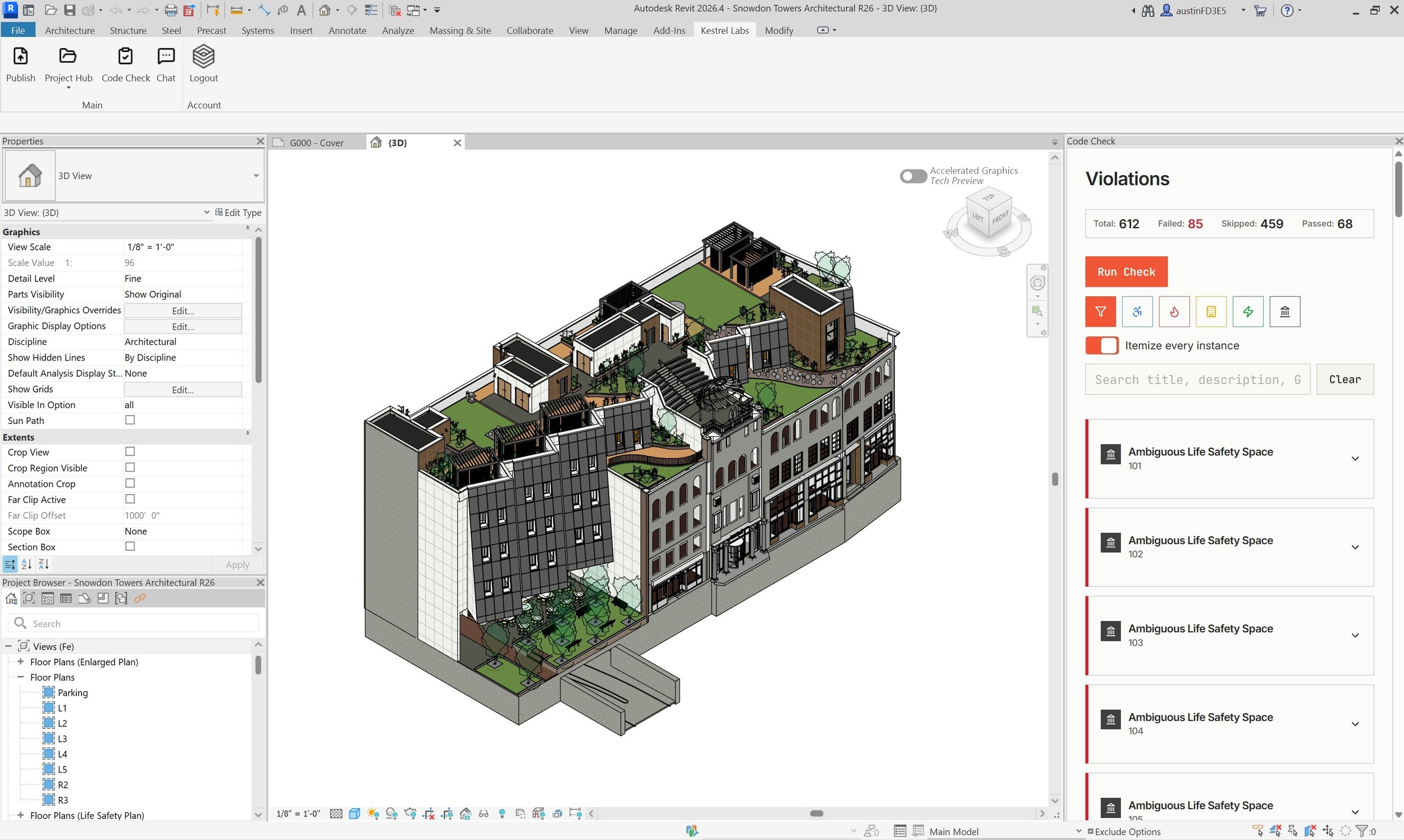
AI evaluates building code compliance directly inside the Revit model, flagging issues tied to specific elements and code sections.
Most discussions about AI in architecture focus on rendering, generative design, or automation broadly.
But one of the most immediate and practical applications of AI in architecture is building code compliance.
Not because it’s new.
Because it’s structured, repetitive, and tightly connected to the model.
The problem: building code lives outside the model
Building code compliance is not just complex. It’s disconnected from how design actually happens.
Codes live in PDFs and legal text
Design lives in the BIM model
Architects sit in the middle, translating between the two
That translation process is where time is lost—and where most errors originate.
By the time issues are caught, they’re often embedded in drawings, coordination, and documentation.
We break down this shift in more detail here:
→ How building code compliance is moving into the BIM model
This is a systemic problem, not a niche one
This isn’t just a workflow inconvenience. It’s structural across the industry.
Research from Autodesk and FMI shows that a large share of time in construction is spent on non-productive activities like searching for information, resolving conflicts, and fixing mistakes.
At the same time, broader industry analysis has pointed out that architecture, engineering, and construction still rely heavily on fragmented, legacy workflows that require constant translation between systems.
The result:
Issues surface late
Rework compounds
Risk increases as projects progress
Why building code compliance is now solvable
For a long time, building code compliance couldn’t be automated in a meaningful way.
Not because the rules were unknown—but because the inputs weren’t structured.
That has changed.
Design now lives in BIM
Model data is structured and queryable
Code data is becoming machine-accessible
This is what makes model-based building code compliance possible.
Where AI fits in building code compliance
AI is often framed as replacing design.
That’s not where it works best in architecture.
In code compliance, the role is much narrower and more useful:
AI translates building code into structured logic that can be evaluated directly against the model.
Instead of:
reading code manually
cross-referencing tables
checking drawings after the fact
The system can:
evaluate requirements continuously
flag issues tied to specific elements
surface the relevant code sections
This is not generative design.
It’s reasoning applied to structured constraints.
From document-based review to model-based compliance
Traditionally, compliance happens after design decisions are made.
That creates a predictable pattern:
late discovery
expensive fixes
coordination overhead
Model-based compliance changes when that check runs.
Instead of reviewing compliance at the end, teams evaluate it during design.
The difference is not incremental. It changes how risk is managed.
What changes when compliance happens during design
When compliance runs during design:
issues surface earlier
rework is reduced
teams don’t rely on plan check to catch problems
The impact is not just speed.
It’s that compliance becomes part of the design process itself.
Where Kestrel fits
Kestrel is built around this approach.
It translates licensed building code data into structured logic that runs directly inside the Revit model, with every issue tied to a specific element and cited to a code section.
If you’re evaluating tools in this space, we break down the current landscape here:
→ What tools exist for building code compliance in Revit
If you want to see how this works in your own model:
