
Model-based building code compliance is gaining industry adoption
Kestrel Labs has been named a finalist in the Trimble 0–60 Challenge, a program recognizing emerging technologies shaping the future of the built environment.
The selection reflects a broader shift across the industry: building code compliance is moving from a manual process into the design environment itself.
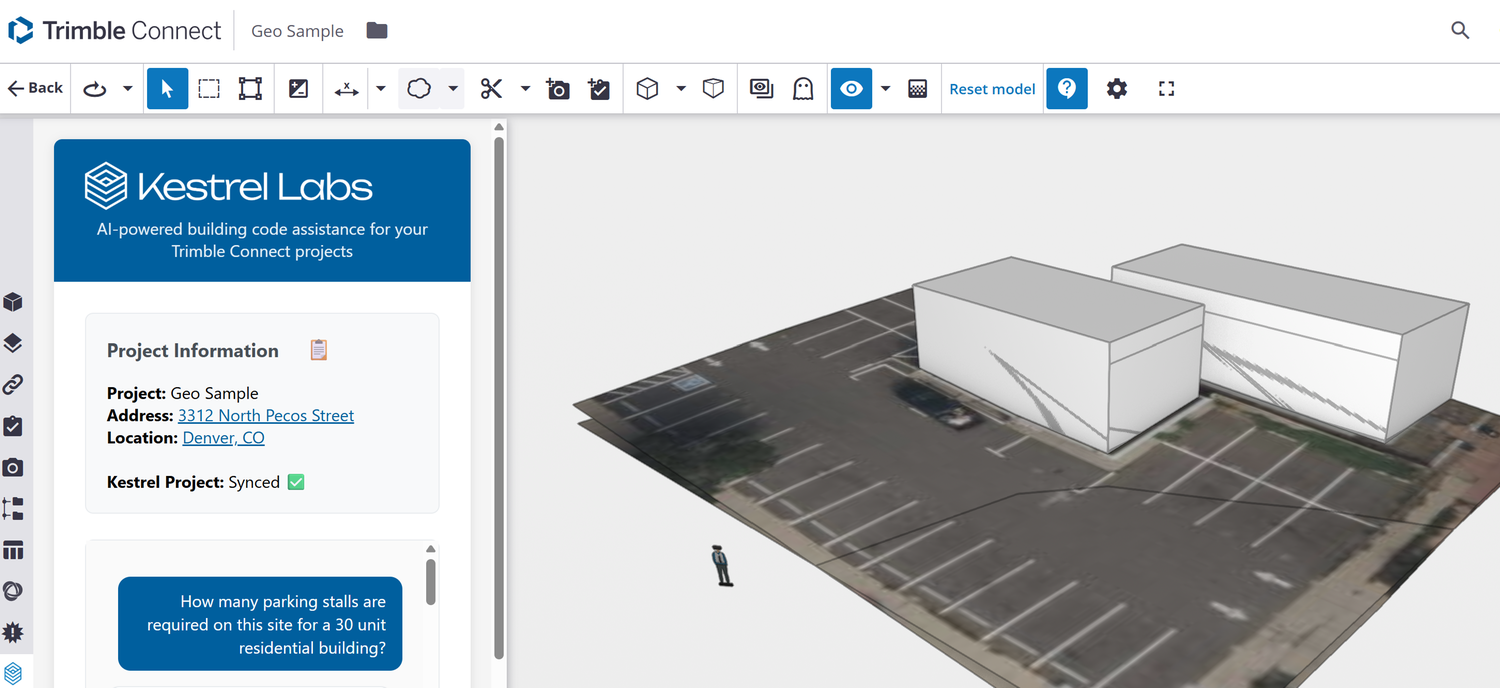
Kestrel running inside Trimble Connect, showing how building code compliance is moving into connected design workflows.
Recognition from the AEC ecosystem
The Trimble 0–60 Challenge highlights companies working at the intersection of design, construction, and data.
Kestrel was selected within the Connected Design category, reflecting a growing focus on systems that bridge the gap between design intent and downstream review processes.
As part of this work, Kestrel is engaging with the broader Trimble ecosystem, including integrations with platforms like Trimble Connect.
This shift is showing up across the industry
The movement toward in-model compliance is showing up across multiple parts of the industry.
Recent analysis of the AEC QA/QC landscape has identified a new class of tools moving compliance earlier into the design process—surfacing issues while the model is still being developed.
At a broader level, firms like a16z have pointed out that much of the built environment is still designed using fragmented workflows that require constant translation between systems.
Building code is becoming machine-readable
One of the core challenges in building code compliance has been access to reliable, structured code content.
Building code has historically lived in PDFs and static documents, requiring manual interpretation and cross-referencing.
Through programs like the ICC Code Connect API, building code can now be accessed directly inside software workflows, with up-to-date code content available programmatically.
Kestrel is part of this ecosystem as an approved technology provider, reflecting a broader shift toward integrating code directly into the tools where design decisions are made.
Design platforms are opening up
This shift is also being supported by broader platform ecosystems.
Kestrel is part of programs including Autodesk’s AECO technology partner network, alongside integrations with connected data environments like Trimble Connect.
Together, these systems are making it possible to move compliance closer to the design process itself.
What this means for design teams
Across code publishers, design platforms, and industry research, multiple independent signals are pointing in the same direction:
Building code compliance is becoming part of the design system—not a separate review step.
We break down this shift in more detail here:
→ How building code compliance is moving into the model
For a definition of how this works:
→ What is model-based building code compliance
And for an overview of the current landscape:
→ What tools exist for building code compliance in architecture
Kestrel’s role in this shift
Kestrel Labs, a Techstars portfolio company, is building a structured compliance data layer for the built environment, translating building code into logic that can be evaluated directly against design models.
If you want to see how this works in practice:
