
I’m a fine artist by training, a technologist by happenstance, and I’m not an architect except by osmosis. My husband and co-founder, Austin, is a licensed architect, and together we started Kestrel Labs to make code compliance visible earlier in design. Today, architects use Kestrel inside Revit to check their designs against building codes licensed directly from the ICC, with findings tied back to the actual elements in their models.
As I build an AI company inside a creative profession, I keep coming back to the question of what happens to our ability to think, and make judgments, as more and more work becomes possible to automate.
Because, as somebody trained in fine art and art and architecture history, I find the idea of handing human artistic and creative pursuits over to AI utterly abhorrent.
I really do.
But I also use AI constantly.
And it has opened an ability for me to create and iterate in realms where I have no formal training. So I spend basically every week living the tension of being a humanist who is building technology, trying to hold the boundary between a tool that expands our ability to create, and one that starts to replace the experience of creating.
And that’s not a very easy line to draw.
Making is part of how we learn what we think
We sometimes talk about creative intent as though you start with a fully formed idea in your head, and then the work is basically the annoying part you have to do to get it out.
That has never been my experience of making anything. Except maybe a human being.
A huge amount of the thinking happens while you’re making.
You try something. You look at it and something isn’t working, or something you didn’t intend is actually much more interesting than what you did intend, so you change direction.
And through all of those little decisions, you’re not just producing the thing. You’re figuring out what you think about the thing.
That’s part of what worries me with the new ease of automating the earliest parts of creative work. It’s not because I think suffering through tedious work is somehow virtuous and morally superior.
It’s because sometimes the work we’re talking about removing is also where the real thinking itself was happening.
AI can expand who gets to participate in making
But this is where my own argument immediately gets complicated.
I would never use AI to do that early exploratory work in painting, or writing, or strategic ideation, places where I have both a natural affinity and decades of experience.
But there are whole other realms where AI has done exactly the opposite of removing me from the creative process. It has allowed me into it.
Last year, I vibe-coded the earliest prototype of what became Kestrel. This year I built our entire website myself in ten days using Claude Code.
The tech world had always seemed like wizardry to me, and suddenly I could take something that had lived only in my head and make it tangible. More importantly, I could ideate in real time, see it and realize, no, that’s not what I meant, change it, try something completely different, and get into the same kind of flow state I recognize from other forms of creative work.
Six months earlier, I couldn’t have made those things at all.
So I can’t make an argument that says technology doing more of the work necessarily means less human creativity. In my own life, I have experienced exactly the opposite.
Agency depends on our ability to understand, choose, and change direction
And that gets at what I mean when I use the word agency here.
Agency doesn’t mean that you personally must do every piece of the work.
We’ve always used tools. We rely on other people’s expertise. We delegate things constantly.
The question for me is whether, after all that delegation, you still understand the work well enough to have a point of view about it, and whether you still have enough influence to do something when your judgment tells you the answer should be different.
Because there is a version of AI where it gives you more ways to explore. It lets you ask more questions, test more ideas, and understand consequences earlier.
And then there’s a version where it frames the problem for you, gives you three answers, tells you which one is best, and eventually your role is basically to click approve.
Those are very different relationships to a tool.
And the difference isn’t about how much work the AI did. It’s about whether using it allowed you to be more involved in the making, or less.
Judgment is developed through the experience of doing the work
But then there’s another problem.
Because we can say that the architect should retain judgment. Fine.
Where does that judgment come from?
It comes from school. It comes from practice. It comes from sitting next to somebody who knows much more than you do, and teaching someone else who knows less. It comes from difficult conversations with clients and contractors. It comes from making mistakes, including incredibly painful mistakes that you discover much later than you wish you had.
Donald Schön wrote about professional knowledge developing through reflection in the act of doing the work itself.
And that’s obviously relevant here because if we change the experience of doing the work, we also must think seriously about whether we’re changing the process by which people become experts.
“Human in the loop” assumes a human who already knows what to question
I hear versions of the following all the time: “Don’t worry, AI can produce the answer, and then a human can verify it.”
Human in the loop: the balm we apply to basically every fear about automating away our discernment.
And okay, sure. But which human?
An architect who has been practicing for thirty years may look at something an AI produced and immediately know that it doesn’t make sense.
What about the person who got out of graduate school a year ago?
Do they inherently know what to question?
Because telling somebody to verify an answer presupposes they already possess the knowledge necessary to recognize when the answer is wrong.
And if the work through which they would historically have developed some of that knowledge has already been delegated, we have to think about where they’re going to get it instead.
I want to be clear that I don’t think the answer is making young architects do tedious tasks forever because that’s how everybody before them came up through the profession.
That would be ridiculous.
My hope is that maybe AI can actually create better ways of learning.
Maybe it can show consequences immediately, in context. Maybe it can help somebody ask questions they wouldn’t have known to ask. Maybe the senior architect can spend less time checking basic work and more time explaining how they think.
Those all seem like entirely plausible, and much better, uses of these tools. And this is the standard by which we should judge new technology.
Does the person understand something afterward that they didn’t understand before? Can they disagree with the tool? Can they explain why?
Because if they can, we’ve probably expanded their agency.
But if they can’t, we’ve just made it easier for them to produce something.
And those are absolutely not the same thing.
Meaningful difference requires particular points of view
Part of why that matters to me is that judgment does not exist in a vacuum. It is necessarily shaped by the experiences of the person exercising it: by what they’ve done, what they notice, what they value, and the other people they’re in dialogue with.
Think about writing. When I read a piece I love, there’s usually something in it I wouldn’t have done myself. A strange connection, a turn of phrase, a choice that initially feels wrong and then makes sense.
I’m encountering another person’s way of seeing.
I want that from architecture too.
Not difference for its own sake, but buildings that effectively respond to different people, different places, different histories, different ways of living.
That’s where I start to get uncomfortable with the idea of turning more and more creative decisions over to a brilliant but ultimately synthetic brain whose fundamental mechanism is generating a probable next step from everything that has already been created.
I don’t want our next creations to become an echo and rhyme of everything we’ve made before.
And of course there’s an obvious problem with this argument, which is that humans are also incredibly good at copying each other.
We absolutely do not need artificial intelligence to create a bland and uniform built environment.
There are already enormous economic pressures pushing architecture toward repetition and efficiency. The particular horror of the liminal space of vinyl-siding five-over-ones, green and greige geometric carpet, 6500-kelvin purgatory existed long before AI.
So maybe the fear isn’t that AI will suddenly drown us in a sea of slop, because we’re already well down that path.
It’s whether these new tools give us more capacity to resist those pressures, or simply enable us to churn banality out faster.
The easiest answer cannot become the default
And despite all accumulating evidence to the contrary over the past few minutes, I am actually an optimist.
I believe that people ultimately want meaning, connection, beauty, and joy. And I can envision a future where we use AI and automation to give ourselves more freedom and grace to spend time on uniquely human pursuits.
But there is absolutely no guarantee that’s what we’re going to do.
If AI makes something take half as long, we won’t necessarily spend the other half contemplating the human condition, beauty, truth, and love.
We may just get twice as much work.
If automation gives us time back, we have to decide what that time is for
We must be deliberate as an industry about what we choose to do with the time automation gives us.
One of my great hopes for these tools is that architects could have more time to iterate.
More time on site.
More time actually talking to the people who are going to use the building.
More time sitting next to somebody junior and explaining why something doesn’t work instead of just redlining it.
More time existing. Go to a museum, bake bread, play guitar, ride a bike. Think, abstract, experience, make.
More time doing all of that intangible stuff that we call living that is incredibly difficult to put on a timesheet but actually gives you perspective and experience to bring back into the work.
Because creativity doesn’t come from nowhere.
Discernment doesn’t come from nowhere.
Taste doesn’t come from nowhere.
And if we automate some of the labor through which people historically developed those things almost as byproducts, then firms and schools have to be intentional about creating other experiences that develop them.
Otherwise we’re going to keep saying that human judgment is essential, while systematically removing the conditions under which people learn how to develop and exercise it.
What must be left to the architect?
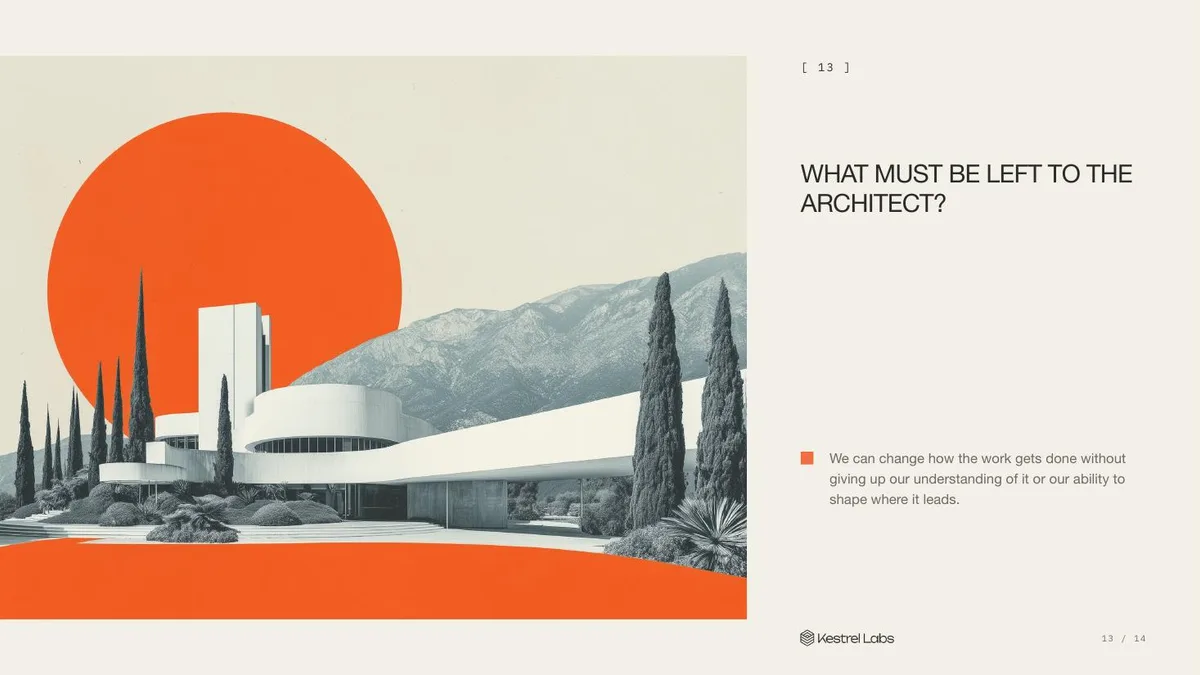
So when I ask what must be left to the architect, my answer isn’t a list of tasks.
It’s not: humans do this part, AI does that part. That line is going to keep moving anyway.
What matters is that, wherever that line moves, people still have the experiences through which they develop judgment, and enough agency to actually exercise it.
Because we all have a deep responsibility for the quality of what we put into the world, no matter what tools we use to make it.
That’s the version of AI I want us to build toward.
Not one where humans have to keep doing everything we’ve always done just because we’ve always done it that way.
One where more people have a meaningful hand in shaping the world around them, and the agency to do it well.
Marian Pulford is Co-Founder and CEO of Kestrel Labs, where she works at the intersection of architecture, technology, and building-code compliance. This essay was adapted from her October 2026 talk at the Texas A&M College of Architecture AI Symposium.
On where the same line falls inside the product itself: Where AI doesn’t belong →